What Can a Golf Rangefinder Measure? An Easy Guide
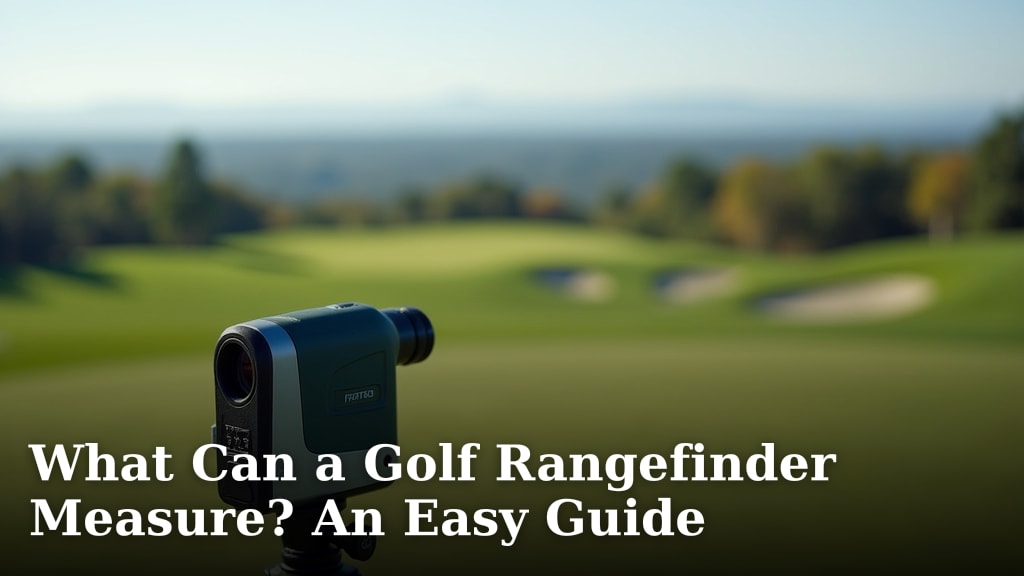
A golf rangefinder measures exact yardage to your target, like the flagstick, hazards, or trees. You get precise distances so you can choose the right club with confidence.
We found these devices are incredibly useful tools for improving your course management. They help you take the guesswork out of your game and focus on your swing instead of estimating distances.
- A golf rangefinder measures the exact distance to the flag, hazards, and other targets.
- Many models also calculate slope-adjusted distances for uphill or downhill shots.
- They use a laser to find the distance to an object you aim at.
- Knowing precise yardages helps you select the correct club.
- This leads to better shot-making and lower scores.
Below, we break down the specific things a rangefinder can measure and how each feature can benefit your game. Let’s walk through the details so you know exactly what to look for.
Exactly What Your Rangefinder Measures
A golf rangefinder is a small, handheld tool that uses a laser to measure how far away an object is. You point it at the flag, a tree, or a bunker, press a button, and it gives you a number. That number is the straight-line distance, in yards or meters, from you to the target.
Think of it like a digital caddie that tells you the yardage instead of pacing it off. This simple, core function removes the guesswork from one of the game’s biggest challenges: distance control.
The Core Measurement: Line-of-Sight Distance
This is the primary job of every rangefinder. It measures the direct, straight-line distance. When you range the flagstick from the fairway, it gives you the exact yardage. This number helps you pick the right club for that particular shot.
We found that for most amateur golfers, simply knowing this number accurately can lead to better club selection. It turns a “I think that’s a 7-iron” shot into a “this is a 152-yard shot, so it’s a 7-iron” shot. That confidence alone is powerful.
Slope-Adjusted Distance: The Game Changer
Many modern rangefinders include a feature called slope or angle compensation. This is where the device gets really smart. It measures not just the distance, but also the angle of elevation or depression to the target.
Why does this matter? An uphill shot plays longer than its flat distance, and a downhill shot plays shorter. A rangefinder with slope calculates the “play-as” distance for you. For example, a 150-yard shot up a steep hill might play like 160 yards. The rangefinder will show you both numbers.
How It Helps Your Score
This feature is a massive help on hilly courses. It prevents the common mistake of under-clubbing on uphill approaches or over-clubbing downhill. Many golfers we’ve spoken with say it’s the single biggest improvement to their course management. It takes the terrain out of the equation.
Important note: for official tournament play under USGA and R&A rules, slope functionality must be turned off. The device becomes a simple distance-only tool for the round.
Key Features That Go Beyond Basic Yardage
While distance is the star, other features make the tool more reliable and easier to use. These aren’t just fancy add-ons; they solve practical problems you’ll face on the course.
Pin-Seeking and Vibration Technology
When you’re aiming at a flagstick with trees in the background, a basic rangefinder might give you the distance to the farthest tree instead of the pin. This is where pin-seeking technology comes in. The device is designed to prioritize and lock onto the nearest target, which is typically the flagstick.
Once it locks on, many models give you a short vibration or flash the display. This tactile feedback is huge. It tells you, “I’ve got the pin, not the tree behind it,” so you can trust the number without squinting at the screen.
Maximum Range and Magnification
Two numbers you’ll see in the specs are maximum range and magnification. The maximum range is the farthest distance the laser can measure, often up to 1,000 yards or more. For golf, you rarely need more than 400 yards, but a longer range ensures it can handle all situations.
Magnification, like 6x or 7x, is how much it zooms in on the target. This helps you see the flag clearly from a long way off. A good balance is important: too little magnification and you can’t see the target; too much and the image can be shaky in your hands.
Scan Mode and Continuous Measurement
This feature lets you hold down the button and sweep the landscape. The display will update in real-time, showing distances to different objects as you pan across. It’s perfect for getting a quick read on everything in front of you—the flag, a bunker lip, a water hazard edge—in one smooth motion.
It’s like taking a yardage snapshot of the whole hole. This helps you plot your strategy and understand the entire challenge of the shot, not just the pin distance.
Slope vs. Non-Slope Models: Which Should You Choose?
This is the biggest decision you’ll make. Your choice depends on why and where you play. Let’s break it down in a simple comparison.
| Feature | Slope-Enabled Rangefinder | Non-Slope (Tournament Legal) Model |
|---|---|---|
| Primary Measurement | Actual distance and slope-adjusted “play-as” distance | Actual line-of-sight distance only |
| Best For | Casual rounds, practice, and playing on hilly courses | Competitive play and tournaments under strict rules |
| Advantage | Complete yardage information for better club selection in all conditions | Complies with all rules; no need to remember to switch it off |
| Typical Price | Higher cost due to the added technology | Generally more affordable |
Many experts and rule committees state that slope devices are perfectly legal for casual rounds. The key is they must be “non-conforming” for competition if the slope function is active. If you ever play in club tournaments, having a separate, compliant device is wise.
Practical Tips for Getting the Most From Your Rangefinder
Owning one is great, but using it well is better. Here are some tried-and-true tips from our research into effective use.
- Stand steady. Brace your arms against your body to reduce shaking and get faster locks.
- Aim for a solid object. Flagsticks are thin. Aim at the base or the center to ensure a good read.
- Use the scan mode to map the entire hole from the tee box before you choose a club off the tee.
- Check the battery regularly. Nothing is worse than it dying mid-round. Keep a spare battery in your bag.
- Practice with it on the range. Range to different flags to get a feel for how it works and what distances you hit with each club.
Your Rangefinder Measurement Checklist
When you’re shopping, make sure the device you’re considering does these things well. This checklist will help you compare models like a pro.
- Accurate Distance Measurement to within one yard.
- Reliable Pin-Lock with vibration or clear indicator.
- Clear Magnification for easy target identification.
- Slope Function (if you want it) that is easy to toggle on and off.
- Durable and Water-Resistant build for rain or morning dew.
We found that focusing on these core functions ensures you get a tool that truly helps your game. A rangefinder isn’t just about knowing a number; it’s about building a strategy for every single shot. With the right measurements in your hand, you can play each hole with a plan.
Conclusion
A golf rangefinder measures more than just yardage. It provides exact line-of-sight distance to the flag, hazards, and trees. Advanced models add slope-adjusted distances for uphill or downhill shots. Features like pin-seeking and scan mode make it a reliable tool for course management. Now that you understand what these devices can do, you’re ready to choose one. Use the checklist from the article to compare models. Practice with your rangefinder on the course to build confidence. This simple tool can help you make smarter decisions and enjoy the game more.
Frequently Asked Questions
Can a golf rangefinder measure distance accurately in fog?
Light fog usually doesn’t affect a rangefinder’s accuracy. However, heavy fog or rain can scatter the laser beam. We recommend using it in clear weather for the most reliable readings. Some models have anti-fog coatings on the lens for better performance.
Do all golf rangefinders measure in both yards and meters?
Yes, most modern rangefinders let you switch between yards and meters. This is a standard feature for convenience. Always check the product details to confirm before buying.
Can I measure the distance to a water hazard edge?
Absolutely, you can aim at any solid object like the lip of a bunker or hazard. The rangefinder will give you the straight-line distance to that point. This helps you plan shots to avoid or clear trouble.
How does a rangefinder’s accuracy compare to a GPS device?
Rangefinders often provide more precise yardages since they measure directly to your target. GPS devices give general distances to fixed points on the hole. We found rangefinders better for detailed shot selection.
What is the typical maximum range for a golf rangefinder?
Most rangefinders can measure up to 1,000 yards or more. For golf, you’ll rarely need distances beyond 400 yards. Focus on accuracy within your usual ranges rather than just the maximum specification.