9 Best Low-Compression Golf Balls (November 2026)
The best low compression golf balls include the Vice Drive Golf Balls for low to medium swing speed, the WILSON Profile Distance Golf Balls 36 Pack for bulk value, and the Callaway Golf Supersoft Golf Balls for greenside control.
On this page (8 sections)
- Best low compression golf balls for soft feel and launch
- How we compared these low compression golf balls
- What does low compression mean on a golf ball?
- Why use low compression golf balls if you swing slowly?
- How do 2-piece and multi-layer balls differ for feel?
- Are low compression golf balls good for the short game?
- How should you choose by swing speed and spin needs?
- Verdict: which low compression golf ball should you buy?
The best low compression golf balls for most golfers are the Vice Drive, because it combines a soft-core 2-piece build for low to medium club head speed with longer roll and softer feel. If you want more spin around the green, the Callaway Supersoft and Vice Pro are stronger picks.
Why use low compression golf balls? You gain easier compression at impact, a softer feel on short shots, and often better launch when your swing speed is not high.
That trade matters more than the label alone.
Low compression also changes how a ball behaves when you miss the centre of the face. A softer core can make off centre strikes feel less harsh, which helps confidence on approach shots.
Our score weighs specs, features and buyer feedback against what you are shopping for. We compared the picks below by construction, core type, cover material, dimple design, pack size and who each ball suits.
We did not test them in person.
Start with your swing speed and your short game needs. For a broader shortlist, see the top 10 best golf balls guide, which covers harder balls too.
Our picks at a glance
-
1

-
2

-
3

- 4
 Check it
TaylorMade SpeedSoft Golf Balls
Best for visibility and distance - 5
 Check it
Amazon Basics Core Soft Golf Balls
Best for beginners on a budget - 6
 Check it
TaylorMade Noodle Long & Soft Golf Balls
Best for a 34 compression feel - 7
 Best for medium swing speed spinCheck it
- 8
 Best for ultra-soft feelCheck it
- 9
 Check it
Callaway Golf Warbird Golf Balls
Best for maximum ball speed
Best low compression golf balls for soft feel and launch
The Vice Drive leads because it matches the core shopper for this search: low to medium speed, soft feel, and roll. The Wilson Profile wins on pack value, while the Supersoft wins on greenside control.
Your priority should decide the final pick.
That priority usually falls into one of three groups. Some golfers need maximum launch help from a soft core.
Others need a soft feel that still spins on chips and pitches. A third group wants distance first and soft feel second.
A fourth practical split is durability. A 2-piece Surlyn or ionomer ball will survive cart paths and wedge scuffs better than a thin urethane cover.
That difference matters if you play the same ball for several holes.
Vice Drive Golf Balls: Best for low to medium swing speed
- 2-piece construction
- 368 dimple design
- Soft-core with rubber core material
- One dozen included
- 1.68 inch diameter
A soft-core 2-piece ball built for low to medium club head speed, with a 368 dimple design for longer roll and softer feel.
Pros
- Soft feel for slower swings
- Tough and cut-resistant soft-core
- Longer roll than harder balls
Cons
- 2-piece limits greenside spin
- White color only in this data
The Vice Drive suits golfers with low to medium club head speed who want a ball that feels soft without giving up roll. Its 2-piece construction keeps the design simple and durable for everyday rounds and casual practice.
Vice says the soft-core is extremely tough and cut-resistant, with a rubber core material and a DuPont Surlyn cover in the description. That matters if you play often, practice around the green, or worry about scuffs from wedges and cart paths.
The 368 dimple design is built for longer roll and softer feel. Longer roll helps on approach shots that land short, while soft feel helps on putts and chips where a hard ball can feel clicky and less controlled.
Trade-off: a 2-piece ball will not match a urethane 3-piece ball for greenside spin. If you need check and bite on approach shots, look at the Supersoft or Vice Pro instead of this firmer covered design.
It comes as 1 dozen golf balls with a 1.68 inch diameter and 16 ounces listed for the pack. That standard size makes it easy to compare with other balls in this list on feel and flight.
Its recommended uses for golf practice and golf game also support buying a dozen for mixed play and practice.
WILSON Profile Distance Golf Balls 36 Pack: Best for bulk value
- Low compression technology for soft feel
- High energy core
- 36 pack
- Composite construction
- Spin reducing dimple pattern
A 36-pack Wilson ball that pairs low compression soft feel with a high energy core for distance flight.
Pros
- 36 balls in one pack
- Low compression soft feel
- Spin reducing dimple pattern for straighter flight
Cons
- Composite build is less premium
- Smaller 1.6 inch diameter listed
The Wilson Profile Distance 36 Pack suits bulk buyers who lose balls or practice a lot. At 36 balls, one pack lasts far longer than a standard dozen and suits range sessions.
Wilson says low compression technology gives a soft feel, while a high energy core enables long distance flight. That pairing is the point of this ball: soft at impact, but still built to travel off the tee.
The spin reducing dimple pattern reduces hooks and slices, according to Wilson, and a specially designed inner cover creates less ball spin to maximize distance. For a distance ball, straighter flight matters as much as raw carry.
Trade-off: composite construction and a 1.6 inch diameter listed in the specs make this less premium than multi-layer urethane balls. Feel on delicate chips will be firmer and less responsive.
Choose it for range sessions and casual rounds where value per ball matters. Choose a softer urethane ball if greenside control and a premium feel are your top priority.
Wilson also lists long distance shots, accuracy and tee to green play as recommended uses, which fits its distance-first brief.
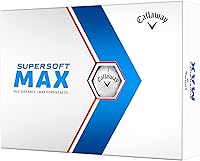
Callaway Golf Supersoft Golf Balls: Best for greenside control
- HyperElastic SoftFast Core
- Hybrid Cover
- Multi-layer construction
- 12 count
- Polyurethane material
A multi-layer Supersoft ball with a HyperElastic SoftFast Core for faster ball speed and soft greenside feel.
Pros
- Soft feel with faster ball speed
- Greenside spin and control
- Strong buyer feedback in data
Cons
- White color in this data
- Multi-layer may feel firmer than ultra-soft cores
The Callaway Supersoft suits golfers who want soft feel plus greenside spin. Compare the Supersoft vs Supersoft Max golf balls before choosing.
Callaway says the HyperElastic SoftFast Core is engineered for faster driver and iron speed with soft greenside feel.
That is a useful combination. Many soft balls feel nice on putts but launch poorly off the driver.
This core aims to keep ball speed up while keeping short shots soft and controllable.
The Hybrid Cover combines distance with soft feel and durability. Callaway also claims a new cover system for enhanced control on approach and short game shots, which helps pitches hold the green.
Trade-off: polyurethane and multi-layer construction may feel slightly firmer than the lowest compression cores here. If you want the softest possible feel, see the Titleist TruFeel or Noodle instead.
It comes in a 12 count pack at 1.68 inches diameter, which is standard for a round ball in this group. Our Callaway soft feel review area is different, but this Supersoft pick shows how Callaway balances speed and feel.
The multi-layer build also separates it from simpler 2-piece distance balls on spin.
TaylorMade SpeedSoft Golf Balls: Best for visibility and distance
- Low-compression PWRCORE
- Multi-layer construction
- 12 count
- Polyurethane material
- Extended flight dimple pattern
A low-compression multi-layer ball with PWRCORE for fast ball speed off the tee and soft feel on irons and around the green.
Pros
- Ultra-soft feel with distance design
- Forgiving everyday performance
- High visibility ink design
Cons
- Multipack color listing
- Mid wedge spin is not high spin
The TaylorMade SpeedSoft suits golfers who want distance with an ultra-soft feel. TaylorMade says a low-compression PWRCORE delivers explosive speed while keeping a soft feel on iron shots and around the green.
That design targets a wide range of shots, from tee to putter. Forgiving everyday performance is the goal, not tour-level spin, so mid shots should feel comfortable even when contact is not perfect.
The high visibility ink design helps the ball stand out on the course. TaylorMade lists vibrant colors in its description, including white, yellow, green, blue, red and pink, with an extended flight dimple pattern.
Trade-off: mid wedge spin is listed, not high wedge spin. If you play firm greens and need the ball to check hard, a urethane 3-piece ball will suit you better than this multi-layer design.
It is a multi-layer ball with a 12 count and polyurethane material. For more color options, see our best golf balls pink guide.
Its item highlights also list bright visibility, soft feel, fast ball speed and enhanced distance, which reinforces the visibility plus distance positioning.
Amazon Basics Core Soft Golf Balls: Best for beginners on a budget
- Low compression
- 2-piece construction
- 24-pack
- Yellow cover
- Side stamp alignment
A 24-pack of yellow low compression balls with side stamp alignment for putting, aimed at beginners to experienced players.
Pros
- 24-pack for practice and play
- Yellow for easy tracking
- Side stamp helps alignment
Cons
- Ionomer cover is firmer than urethane
- Yellow color may not suit all players
The Amazon Basics Core Soft suits beginners and budget buyers who want a lot of balls for practice. The 24-pack gives you twice a standard dozen for range work and casual rounds.
Amazon Basics says the low compression design delivers distance and straight flight with soft feel on impact. Advanced core and cover technology aims to improve short game control and putting accuracy across all clubs.
The side stamp alignment feature helps line up putts. That is a practical detail if you struggle with starting your putts on line, and it works with the durable yellow cover for easy tracking.
Trade-off: the yellow ionomer cover will feel firmer and spin less than urethane covers. It is also yellow only, which some players avoid, and the 2-piece build limits greenside bite.
It is USGA conforming and suited for all skill levels from beginners to experienced players. For a deeper look at soft options, see our best soft golf balls list.
At 42.8 millimeters diameter, it also sits close to standard balls for consistent putting feel.
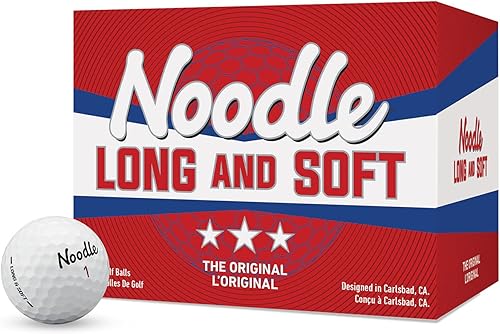
TaylorMade Noodle Long & Soft Golf Balls: Best for a 34 compression feel
- Ultra-soft 34 compression core
- Patented dimple design
- Durable soft iothane cover
- Impact propulsion core
A TaylorMade ball with a 34 compression core, soft iothane cover and patented dimple design for straighter flight.
Pros
- Very low 34 compression
- Great feel and increased greenside spin
- Dimple design for straighter flight
Cons
- Pack size listed as 15 BP
- Plastic material type listed
The TaylorMade Noodle Long & Soft suits golfers who want a very low compression number. Its 34 compression core is the lowest stated number in this group, with a soft compression core in a multi-layer build.
TaylorMade says the core gives great feel and increased spin around the greens. A durable soft iothane cover pairs with an impact propulsion core for longer carry on full shots.
The patented dimple design is built for straighter flight. TaylorMade's description lists 342 dimples placed to reduce air resistance, which helps the ball penetrate the air more efficiently.
Trade-off: the plastic material type and 15 BP pack size make this a simpler, more basic ball than the multi-layer urethane picks. Greenside spin is good for its class, but not tour-level.
It suits recreational and senior golfers, according to TaylorMade. If you want a proven soft feel, also check the Bridgestone e6 soft review for comparison.
The aerodynamic dimple and soft core combination is aimed at golfers who want straight flight without a firm impact.
Vice Pro Golf Balls: Best for medium swing speed spin
- 3-piece cast urethane cover
- Extra-thin cover
- 12 count
- Polyurethane material
- Closed alignment line
A 3-piece cast urethane ball designed for advanced golfers with medium swing speeds, with high short game spin.
Pros
- High short game spin
- Soft feel off the club
- Alignment line for aiming
Cons
- Not the softest core here
- Best for medium speeds, not the slowest
The Vice Pro suits advanced golfers with medium swing speeds who still want soft feel. Its 3-piece cast urethane cover construction is a step up from 2-piece balls for spin and control.
Vice says the extra-thin cover gives high short game spin. That helps approach shots check and hold the green, which 2-piece balls rarely match even with a soft core.
The ball is designed to maximize driver distance at medium swing speeds. Outstanding spin control and soft feel off the club are the stated goals for this standard size ball.
Trade-off: this is not the softest or lowest compression ball here. It is built for spin and control first, so the slowest swingers may get more launch from the Vice Drive.
It comes in a 12 count with a closed alignment line for better aiming and a 1.68 inch diameter. For TaylorMade-specific options, see our best TaylorMade golf balls guide.
The polyurethane material and extra-thin cover also explain its stronger greenside bite compared with Surlyn or ionomer covers in this list.
Titleist TruFeel Golf Balls: Best for ultra-soft feel
- TruTouch core
- 376 tetrahedral dimple design
- Softer 3.0 TruFlex cover
- Multi-layer construction
- 12 count
Titleist's softest ball in this group, with a TruTouch core, TruFlex cover and 376 tetrahedral dimples for low penetrating flight.
Pros
- Ultra-soft feel
- Increased greenside spin and control
- Long distance with soft feel
Cons
- Low penetrating flight may not suit all
- Scores lower here for pure distance focus
The Titleist TruFeel suits players who prioritize soft feel and trust the Titleist brand. Titleist says it is their softest ball, with a TruTouch core for long distance and soft feel.
The softer 3.0 TruFlex cover aims to increase greenside spin and control. For a very soft ball, that spin help matters on chips and pitches where you need the ball to stop quickly.
The 376 tetrahedral dimple design gives a low penetrating ball flight. That flight shape suits players who want the ball to stay lower and roll out more after landing.
Trade-off: low penetrating flight is not for everyone. If you need high launch to hold firm greens, the Warbird or SpeedSoft may suit you better than this lower flight profile.
It is a multi-layer ball in a 12 count with polyurethane material and 1.68 inch diameter. For firmer speed, compare the best high compression golf balls guide.
Its position as a soft-feel first ball also makes it a clear alternative to distance-first 2-piece builds.
Callaway Golf Warbird Golf Balls: Best for maximum ball speed
- Extra-large high-energy core
- 2-piece construction
- HEX Aerodynamics
- 12 count
- Highly compressible core
A 2-piece distance ball with an extra-large highly compressible core and HEX Aerodynamics for high launch and long carry.
Pros
- Maximum ball speed design
- High launch and long carry
- Great greenside feel for a distance ball
Cons
- 2-piece construction
- Distance focus over softest feel
The Callaway Warbird suits golfers who want maximum ball speed with a compressible core. Callaway says the extra-large high-energy core is highly compressible to gain more distance.
HEX Aerodynamics reduces drag and promotes increased launch. Callaway says that means more speed, better ball flight and more distance, with long carries on full swings.
The 2-piece construction keeps it durable and simple for everyday play. Great greenside feel and control are claimed for a distance ball, which helps on short shots despite the distance focus.
Trade-off: this is a distance-first ball, not the softest feel in the group. If soft feel is your top priority, the TruFeel or Noodle will feel softer around the green.
It comes in a 12 count with rubber material listed. If your swing speed is slow, also read our best golf balls for slow swing speed guide before you decide.
The highly compressible core is the key difference from firmer distance balls that need more club head speed to work.
How we compared these low compression golf balls
We compared construction first, because 2-piece, composite, multi-layer and 3-piece balls play differently. We then checked core claims, cover material and dimple design.
We also matched each ball to a swing speed or skill level. A ball for a slow swinger needs different compression than a ball for a medium swinger who wants spin.
Pack size mattered for value. A 36-pack and a 24-pack cost less per ball for practice, while a 12-count is standard for a single round.
We weighted the stated purpose of each ball over raw dimple count. A 342 dimple design for straight flight and a 376 tetrahedral design for low penetration are solving different problems.
How construction affects spin and feel
Construction shapes the trade between durability and control. A 2-piece ball usually rolls more and spins less.
A 3-piece urethane ball usually spins more and feels softer on chips.
Cover material also matters for that control. Urethane covers tend to grip the clubface more than ionomer or Surlyn covers.
That grip is why urethane balls check better on approach shots.
Dimple count and pattern affect flight rather than feel alone. A 368 dimple design, a 376 tetrahedral design and a 342 dimple design will each shape launch and roll differently.
We weighed those claims against the stated purpose of each ball rather than treating dimple count as a score on its own.
Core size also changes the feel. An extra-large high-energy core, as in the Warbird, compresses differently from a smaller soft core in a 2-piece ball.
That is why two low compression balls can feel quite different on full swings.
How pack size affects value
Pack size changes how you should judge value. A 36-pack Wilson ball or a 24-pack Amazon Basics ball spreads cost across practice, while a single dozen suits tournament play.
We treated pack size as a practical factor, not as a performance score.
What does low compression mean on a golf ball?
Low compression means the core compresses more easily when the club hits it. You feel a softer impact, and slower swings can launch the ball with less effort.
Compression is not the only factor. Cover material, dimple design and core size also affect launch, spin and feel.
A low compression ball can still be built for distance. A high energy core, an extra-large core or aerodynamic dimples can keep ball speed up even when the core feels soft.
For putting, low compression usually means a muffled sound and less rebound off the face. Some golfers love that muted feel.
Others prefer a firmer click, so feel preference matters as much as launch.
Compression numbers and why they matter
A stated number such as 34 compression for the Noodle gives a clearer comparison than a general soft label. Other balls in this list do not state a number, so we compared them by core description and intended swing speed instead.
Why use low compression golf balls if you swing slowly?
Who benefits most from a soft core?
Slow to medium swingers benefit most. They get help launching the ball and a softer feel on putts and chips.
Fast swingers may find the ball too soft and lose ball speed.
If your driver swing feels short, start with the Vice Drive or Wilson Profile. Both pair soft feel with distance designs.
Senior and recreational golfers often benefit for the same reason. A core that compresses easily can turn a low speed strike into a useful launch instead of a low roller.
Beginners also benefit on short shots. A soft core reduces the harsh feel of a thin strike, which can make practice around the green more enjoyable.
Launch help is not only about the driver. Irons and fairway woods also benefit when the core compresses fully, so a soft ball can improve carry across the bag.
How do 2-piece and multi-layer balls differ for feel?
2-piece balls for durability and roll
2-piece balls like the Vice Drive and Warbird are tough and roll well. They spin less on greenside shots, which can mean less check on approach shots.
That durability helps if you play woodland courses or lose balls often. A cut resistant cover can survive more rounds without looking worn.
Multi-layer balls for spin and control
Multi-layer balls like the Supersoft, SpeedSoft and TruFeel add spin control. Urethane covers, like the Vice Pro, give the most greenside bite.
The layering also lets brands tune feel by shot type. A core can be soft for launch while a cover adds grip for chips and pitches.
Composite construction, as used by the Wilson Profile, sits between these options. It focuses on distance and straight flight rather than premium greenside performance.
Layer count alone does not guarantee soft feel. A multi-layer ball with a firm core can feel harder than a 2-piece ball with a very soft core, so check the core claim as well as the construction label.
Are low compression golf balls good for the short game?
Yes, if you value soft feel on putts and chips. A soft core reduces the clicky feel that hard balls can have around the green.
For the most spin, choose a urethane 3-piece ball. For soft feel with moderate spin, choose the Supersoft or TruFeel.
Putting alignment aids can help in this area too. A side stamp or closed alignment line gives you a visual cue for starting the ball on your intended line.
Distance balls can still work around the green if the cover is soft. The Warbird and Noodle both claim greenside feel despite a distance focus.
Soft feel on chips also depends on cover grip. A soft core with a low grip cover may land soft but skid, while a urethane cover can bite and stop the ball faster.
How should you choose by swing speed and spin needs?
Slow swing speed: pick the softest launch help
Pick the Vice Drive, Noodle Long & Soft or Amazon Basics Core Soft. These balls emphasize easy compression and soft impact.
The Noodle is attractive here because its 34 compression core is explicitly stated. The Vice Drive is attractive because it pairs soft feel with longer roll.
Medium swing speed: pick spin plus soft feel
Pick the Vice Pro or Callaway Supersoft. Both balance ball speed with greenside control for medium speeds.
That balance matters when you hit full wedges and want the ball to stop. A soft core alone will not create check without a grippy cover.
Distance first: pick a compressible core
Pick the Wilson Profile, Warbird or SpeedSoft. Each pairs a soft or compressible core with a distance design.
Look at dimple and aerodynamic claims in this group. HEX Aerodynamics, an extended flight dimple pattern and spin reducing dimples all aim to keep the ball flying straighter and longer.
Pack size should also guide this choice. A 36-pack suits high volume practice, while a 12-count suits a single competitive round.
High launch versus low penetration is another split here. The Warbird promotes high launch, while the TruFeel promotes a low penetrating flight, so match flight shape to your course and iron play.
Verdict: which low compression golf ball should you buy?
Pick the Vice Drive if you want the best all-round soft feel for low to medium swing speed. Pick the Wilson Profile 36 Pack if you want bulk value for practice.
Pick the Callaway Supersoft if greenside spin matters most.
For the softest feel, see the Titleist TruFeel. For the most spin at medium speed, see the Vice Pro.
Match the ball to your swing speed first, then to your short game needs.
Our top 3 picks at a glance
-
1
-
2
-
3
Frequently asked questions
Why use low compression golf balls?
Low compression balls compress more easily at impact, so slower swings can launch them better. They also tend to feel softer on putts and chips.
Choose them if you want more carry and a softer touch without changing clubs.
Are low compression golf balls good for slow swing speed?
Yes, they are often a good fit for slow swing speed. A softer core helps you transfer energy at lower club head speeds.
Compare our guide to the best golf balls for slow swing speed for more detail on matching ball to speed.
Low compression vs high compression, which should I pick?
Pick low compression if your swing is slow to medium and you want soft feel. Pick higher compression if you swing fast and want a firmer ball that compresses fully.
The right choice depends on launch, feel and spin needs.
Do low compression golf balls lose distance?
Not necessarily. Many low compression balls here use high energy cores to keep ball speed up.
The Vice Drive, Wilson Profile and Callaway Warbird all pair soft or compressible cores with distance designs, so feel does not have to mean short.
Which low compression ball gives the most greenside spin?
In this group, the Vice Pro and Callaway Supersoft emphasize greenside spin. The Vice Pro uses a 3-piece cast urethane cover with an extra-thin cover.
The Supersoft uses a new cover system for approach and short game control.