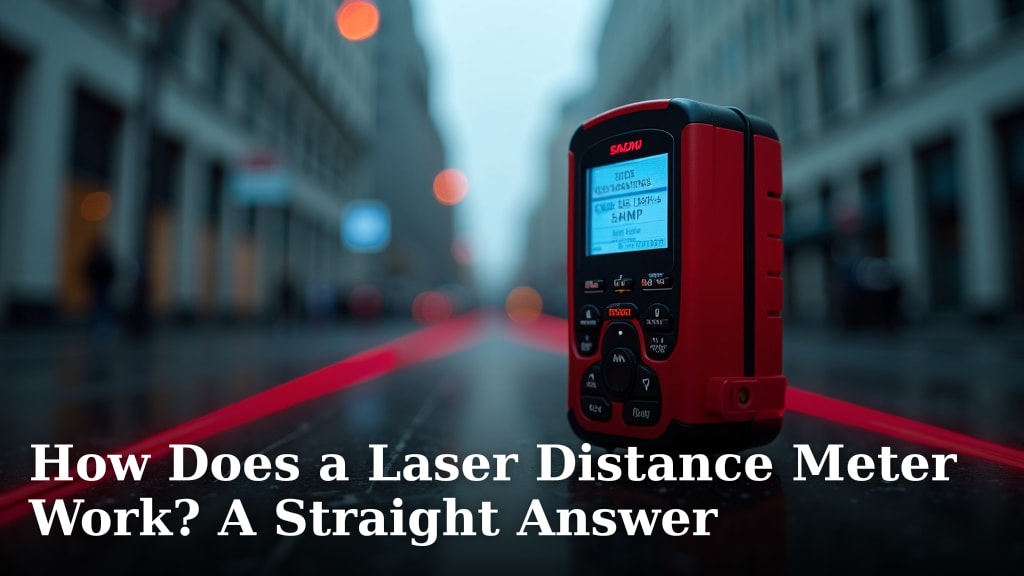
How Does a Laser Distance Meter Work? A Straight Answer
A laser distance meter works by sending out a laser beam and timing how long it takes for the beam to bounce off an object and return. This measurement tells the device the exact distance to that object. Think of it like a super-fast echo. It’s a clever way to measure quickly and accurately.
These handy tools use a high-speed timer to calculate distances. The laser pulse is incredibly quick. When it hits a surface, it reflects back to the meter. The meter then uses the time difference to figure out how far away something is. It’s much faster than a tape measure for longer distances.
- Laser distance meters measure by timing a reflected laser beam.
- A pulse of light is sent out and times its return.
- This time tells the meter the exact distance.
- It’s a quick and accurate measuring method.
Let’s walk through exactly how this works step by step so you can understand your new favorite measuring tool.
Understanding How Laser Distance Meters Measure
Laser distance meters use a clever principle to give you accurate measurements. They send out a beam of light. This beam travels to a target. Then, it bounces back to the meter. The meter precisely times this round trip. It’s like playing a super-fast game of echo tag with light.
The Core Technology: Time-of-Flight
The main technology behind these devices is called time-of-flight. You’ve probably heard of echoes. When you shout in a canyon, the sound bounces back. Your laser meter does something similar. It sends out a laser pulse. This pulse travels incredibly fast. It hits your target surface. The light reflects off that surface. It then travels back to the meter’s sensor. The meter’s internal clock starts the moment the pulse is sent. It stops when the reflected pulse is detected. This tiny time difference is the key.
How Time Becomes Distance
Light travels at a constant speed. We know this speed very precisely. It’s about 299,792 kilometers per second (or about 186,282 miles per second). This speed is often represented by the letter ‘c’. Because the speed of light is fixed, distance can be calculated. The formula is simple: Distance = Speed × Time. But since the light travels to the target and back, we need to account for that. So, the actual distance to the target is half the total travel time multiplied by the speed of light. Many laser distance meters do this calculation instantly. They then display the result on their screen.
The Laser Pulse: More Than Just a Beam
It’s not just any light that’s sent out. Laser distance meters use a specific type of light. It’s a focused beam of light. This beam is typically in the red or green spectrum. This focused nature is important. It allows the meter to pinpoint a small spot on your target. This means you can measure precisely. Even if there are other objects nearby. The beam is also very brief. It’s a short pulse, not a continuous stream. This brief pulse is crucial for accurate timing. A continuous beam would make it hard to know when the reflection started.
Why a Short Pulse Matters
Imagine trying to time a continuous sound. It would be confusing. But timing a quick “bang” is much easier. The laser pulse is like that “bang.” It’s a sharp, defined event. The meter is designed to detect the exact moment this pulse returns. The shorter the pulse, the more precise the timing can be. And more precise timing means more accurate distance readings. Many modern meters use very short pulses. They can be just a few nanoseconds long. A nanosecond is one billionth of a second. That’s incredibly fast!
The Receiving End: Detecting the Return Signal
On the front of your laser distance meter, you’ll see a lens. This lens is for the laser beam going out. Next to it, or sometimes integrated, is another lens. This one is for detecting the reflected laser light. When the pulse bounces back, it hits this sensor. The sensor converts the light signal into an electrical signal. This signal is then fed into the meter’s processor. The processor is where all the magic happens. It uses the electrical signal to stop the timer.
Sensitivity and Interference
This receiving sensor needs to be very sensitive. It has to pick up the faint reflected light. Especially from far away targets. Or surfaces that don’t reflect light very well. Some materials absorb more light. Others scatter it. Shiny surfaces can reflect strongly. Dark surfaces reflect weakly. The meter’s design accounts for this. It amplifies the weak signals. It filters out unwanted noise. This helps ensure an accurate reading. Interference from ambient light can be an issue. Meters are designed to filter out sunlight. They focus only on the specific wavelength of their own laser.
The Brains of the Operation: The Processor and Timer
Every laser distance meter has a small computer chip inside. This is the processor. It’s programmed with the speed of light. It receives the timing data from the timer. It performs the calculation we discussed earlier. Distance = (Speed of Light × Time) / 2. The processor then converts this distance into your preferred units. This could be feet, meters, inches, or yards. Finally, it sends the number to the display screen. All of this happens in a fraction of a second. It’s quite remarkable engineering.
Accuracy Factors and Calibration
The accuracy of your meter depends on a few things. The quality of the timer is a big one. How precisely it can measure those tiny fractions of a second. The optics also play a role. How well the laser is collimated (kept in a straight line). And how well the sensor picks up the return beam. Most meters are factory calibrated. This means they are set up precisely. They ensure the speed of light used in calculations is correct. For most users, this factory calibration is more than enough. You don’t need to worry about it. Just treat your meter with care.
Putting It All Together: A Step-by-Step Measurement
So, let’s walk through what happens when you use your meter. You aim it at a wall. You press the button. Here’s the sequence:
- Step 1: Aiming. You point the red or green laser dot at your target.
- Step 2: Firing the Pulse. You press the measurement button. The meter sends out a short laser pulse. Its internal timer starts immediately.
- Step 3: Reflection. The laser pulse hits the target surface. Some of the light bounces back towards the meter.
- Step 4: Detection. The sensor on the meter detects the returning laser pulse. The timer stops.
- Step 5: Calculation. The processor takes the elapsed time. It applies the speed of light. It calculates the distance.
- Step 6: Display. The final distance is shown on the screen. Usually in your chosen units.
Common Measurement Scenarios and Tips
These meters are fantastic for many tasks. Measuring room dimensions is a breeze. Checking the length of a fence line is quick. Even measuring the height of a tree is possible. For best results, aim at a solid, flat surface. Avoid measuring to surfaces that are very dark or absorb light. Like black velvet or a dark, matte paint. Shiny surfaces can also be tricky. The reflection might scatter. For these, holding a piece of paper or a light-colored card against the target can help. This provides a better surface for the laser to bounce off. Many meters have features like continuous measurement. This lets you track changes as you move the meter.
Why Not Just Use a Tape Measure?
You might wonder why you need this tech. Tape measures are great for short, straight lines. But they have limitations. For long distances, they can sag. They can be hard for one person to manage. Reaching high ceilings or across large rooms is difficult. Laser distance meters solve these problems. They offer one-person operation. They provide instant readings. They can measure much farther than a tape measure. Many also offer advanced functions. These include area, volume, and Pythagorean calculations. These help you get more done with one tool.
Checking Your Meter’s Performance: A Quick Guide
How can you tell if your meter is working well? Here’s a simple checklist. It helps you feel confident in your readings:
- Is the laser dot visible on the target?
- Does the meter display a reading after you press the button?
- Does the reading seem reasonable for the distance?
- Can you get a similar reading by measuring back and forth?
- Does the meter seem to detect different surfaces consistently?
- Are the units (feet, meters) displayed correctly?
If you are consistently getting weird or no readings, consult your manual. There might be a setting you can adjust. Or it might be time for a check.
Conclusion
You now understand how your laser distance meter works. It sends out a focused light pulse and precisely times its return journey. This time-of-flight principle, combined with the known speed of light, allows for incredibly quick and accurate measurements. You’ve learned about the laser pulse, the sensor, and the internal processor that makes it all happen. This technology is a huge upgrade from traditional measuring tapes for many tasks. To get started, practice on a few easy measurements around your home. Then, try it for your next DIY project.
Frequently Asked Questions
Can I use a laser distance meter in bright sunlight?
Yes, you generally can. While bright sunlight can make the laser dot harder to see, the meter itself is designed to filter out ambient light. It focuses only on the specific wavelength of its own laser pulse for accurate readings.
What happens if I aim at a dark or shiny surface?
Dark surfaces absorb more light, making the reflection weaker and potentially leading to less accurate readings or no reading at all. Shiny surfaces can scatter the laser beam, making it harder for the sensor to detect a clear return signal. For these surfaces, holding up a piece of paper can provide a better target.
How accurate are laser distance meters typically?
Most consumer-grade laser distance meters are very accurate, often to within 1/16th of an inch or 1-2 millimeters. Their accuracy depends on the quality of the internal timer, the optics, and how well they are factory calibrated.
Do I need a special target for measurements?
For most standard measurements, a solid, flat surface like a wall or a door is sufficient. You only typically need a separate target, like a piece of paper or a card, if you’re measuring to a very dark, very shiny, or irregular surface that doesn’t reflect the laser well.
Can a laser distance meter measure curves or irregular shapes?
Laser distance meters are designed to measure the straight-line distance from the meter to the point where the laser dot lands. They cannot directly measure the length of a curve or the dimensions of a complex, irregular shape. Some advanced models have features to help with indirect measurements, like calculating height using triangles.