9 Best Golf Putting Training Aids (November 2026)
The best golf putting training aids include the Genuine EyeLine Golf Alignment Putting Mirror for setup alignment, the Perfect Practice Putting Mat & Golf Chipping for daily home practice, and the FAFAMESO Golf Putting Mat for office and home use.
On this page (8 sections)
- How we compared these golf putting training aids
- The best golf putting training aids for alignment and distance control
- How these were compared
- Which putting training aid should you buy first?
- How do golf putting training aids help with alignment, stroke and distance?
- What should you look for when you compare putting training aids?
- How should you practice with putting training aids for best results?
- Verdict: the best golf putting training aids for your game
The best golf putting training aids for most golfers are a mirror for setup and a mat for distance reps. The EyeLine mirror scores highest here because it covers eye position, face alignment, gate work and stroke length in one compact tool.
The Perfect Practice mat is close behind for golfers who want continuous home practice.
Your biggest putting leak should decide your first purchase. If you miss left and right, start with alignment.
If you leave putts short or long, start with distance work. If your stroke feels tense or wristy, start with a feel trainer.
Our score weighs specs, features and buyer feedback against what you are shopping for. We compared size, portability, feedback type and practice setting across all nine picks.
Our picks at a glance
-
1
 Best for setup alignment
Genuine EyeLine Golf Alignment Putting Mirror
9.7/10 our score
See it on Amazon -
2
 Best for daily home practice
Perfect Practice Putting Mat & Golf Chipping
9.6/10 our score
See it on Amazon -
3

- 4
 Check it
WHYGOLF Putting System & Putting Thing
Best for adjustable gates - 5
 Check it
GoSports Down the Line 10 ft Putting
Best for reading the line - 6
 Check it
Callaway Odyssey Golf Putting Mirror Training Aid
Best for simple mirror work - 7
 Best for face angle controlCheck it
- 8
 Check it
APEX GOLF PERFORMANCE Golf Putting Practice Training aid
Best for stroke arc - 9
 Check it
Orange Whip Golf Putting Aid Trainer
Best for pendulum feel
How we compared these golf putting training aids
We looked at what each aid measures, where you can use it, and how much setup it needs. A mirror scores for setup feedback, a mat scores for distance reps, and gates score for face angle control.
We checked dimensions, included parts and portability so you can see what fits your bag, floor or office. We also noted trade-offs, because a tool that does everything often does one job less clearly than a focused tool.
For broader context, our guide to golf practice net options covers full-swing practice, while the picks below stay focused on putting.
How feedback type changed the ranking
Feedback type mattered more than brand or feature count. A mirror that clearly shows eye position will help a new golfer faster than a mat with many drill options but no setup reference.
Distance tools ranked highly for home practice because they keep balls returning and allow longer putts. That makes them practical for golfers who cannot reach a green daily.
We also weighed how quickly each tool can be set up and put away. Tools that take two minutes to set up tend to get used more often than tools that need ten minutes of assembly.
The best golf putting training aids for alignment and distance control
These nine picks cover mirrors, mats, gates, a string guide, an arc set and a feel trainer. Choose by the habit you want to change, not by the longest feature list.
Genuine EyeLine Golf Alignment Putting Mirror: Best for setup alignment
- 11.75 x 5.75-inch mirror
- Eye position and ball position lines
- Putter gate slots and stroke restrictor hole
- Protective carry bag included
A compact mirror that shows eye position, ball position and putter face alignment at a glance. It suits golfers who want instant setup feedback indoors or on the green.
Pros
- Clear setup lines for eyes and putter face
- Gate slots and stroke restrictor in one tool
- Fits in most golf bags
Cons
- Small mirror face needs close setup
- Gate tees or posts are not included
This mirror suits beginners, juniors and scratch golfers who want setup feedback they can trust. EyeLine lists an 11.75 x 5.75-inch mirror in acrylic, with a protective carry bag included.
You get eye position, ball position and putter face lines in one view. That matters because small setup errors multiply on long putts.
The marked face line helps you aim square to your start line.
Built-in gate slots let you set a custom gate with tees or compatible indoor posts. That gives sweet spot feedback without buying a separate gate set.
A stroke restrictor hole helps shorten a long backstroke and encourage acceleration through impact.
At 4 oz, it fits easily in most bags for green or home use. It works for right- and left-handed golfers, and the foldable form helps with storage.
For daily use, the acrylic face is light but needs care in the bag, which is why the carry bag matters. The TPR back helps it sit on different surfaces.
Trade-off: tees or posts for the gate slots are not included. If you want a dedicated gate drill, our golf putting gate drill guide pairs well with this mirror.
Perfect Practice Putting Mat & Golf Chipping: Best for daily home practice
- 9 ft 6 in length
- Automatic ball return
- Two holes with alignment guides
- Crystal velvet true-roll turf
A long indoor mat with ball return and two holes for short and long putts. It suits daily home practice where space allows a full-length setup.
Pros
- Ball return keeps reps continuous
- Two hole sizes for variety
- Alignment lines and pace markers
Cons
- Needs about 10 ft of clear floor space
- Less portable than a mirror or gates
This mat suits golfers who want daily indoor practice with minimal interruption. Perfect Practice lists a 9 ft 6 in length, which allows work on both short and longer putts.
The automatic ball return keeps sessions continuous. You putt, the ball comes back, and you putt again without walking to fetch it.
That matters for repetition when you have 15 minutes before work.
Two holes, one regulation size and one reduced size, plus alignment lines and pace markers, support accuracy and distance control. The crystal velvet surface is designed for a smooth, true roll at home.
The mat is foldable and weighs 8 oz in the specs, so storage is simple when floor space is shared. Instructions and ball return rails are included.
The longer length matters for speed work, because you can judge whether a stroke that feels right actually travels the distance. Pace markers help you compare a soft and a firm stroke on the same surface.
Trade-off: you need about 10 ft of clear space. If you only have a small corner, a mirror or gates will fit better.
For setup guidance, see how to use a golf putting alignment mirror.
FAFAMESO Golf Putting Mat: Best for office and home use
- 9.8 ft length
- Automatic ball return with baffle plate
- Regulation 3.5-inch and 2.5-inch holes
- Crystal velvet mat with solid wood base
A 9.8 ft mat with two hole sizes and a sturdy wood base for home or office practice. It suits golfers who want distance work plus a smaller-hole challenge.
Pros
- Longer than many indoor mats
- Solid wood base helps it lie flat
- Two hole sizes add challenge
Cons
- Heavier to move and store
- Return track takes extra floor space
This mat suits home office and living room practice where a sturdy base helps. FAFAMESO lists a 9.8 ft length with a crystal velvet mat on a solid wood base.
Two holes are included: a regulation 3.5-inch hole and a smaller 2.5-inch hole. The smaller hole adds challenge once your speed control is steady.
A baffle plate sends holed balls back through the return track.
The wood base gives the mat thickness that helps prevent wrinkling or creasing. That helps the ball roll more consistently than a thin mat on carpet.
It folds and rolls for storage, and the magnetic track tucks away when you finish. The specs list auto ball return boards and the mat with wood base.
The synthetic rubber back also helps grip the floor, which is useful during longer sessions. That stability means you can focus on stroke rhythm rather than adjusting the mat.
Trade-off: at 4.41 kg, it is heavier than the other mat pick. That weight helps stability but makes moving it between rooms less casual.
For wind and green work outdoors, a string guide may serve you better.
WHYGOLF Putting System & Putting Thing: Best for adjustable gates
- Adjustable putter and ball gates
- 1/16 inch thick aluminum alloy
- Alignment rail included
- Travel bag included
An all-in-one system that combines mirror, gates and alignment rail ideas in adjustable form. It suits golfers who want to tune gate width to their stroke.
Pros
- Fully adjustable gates
- Thin and durable construction
- Works on green or carpet
Cons
- More setup time than a fixed mirror
- Adjustment needs care to stay repeatable
This system suits golfers who want adjustable gates rather than fixed slots. WHYGOLF describes the Putting Thing as combining mirror, gate and training elements in one tool.
Patent-pending adjustable putter and ball gates let you set width to your current skill. Start wide for confidence, then narrow the gate as center contact improves.
That progression gives measurable feedback over weeks.
The unit is only 1/16 inch thick in high-strength aluminum alloy. That thin profile helps it sit flat on a green or carpet without feeling bulky under the ball.
An alignment rail and travel bag are included. The rail supports setup drills, and the bag helps with transport between home and the course.
At 0.37 kg, it travels easily and works for kids and adults. The plastic construction listed in the specs keeps the system light for repeated travel.
Trade-off: adjustability takes setup time. If you want instant feedback with no tuning, a fixed mirror is faster.
Our best golf putting gates guide compares fixed gate options in more detail.
GoSports Down the Line 10 ft Putting: Best for reading the line
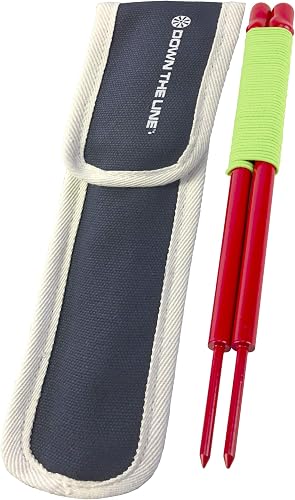
- 10 ft putting string
- Two stakes and travel case
- Works for straight and breaking putts
- Visual line over the ball path
A string guide that shows the intended line to the hole without touching your stroke. It suits green practice focused on start line and break.
Pros
- Shows line without encumbering swing
- Fast setup on a real green
- Good for breaking putt aim
Cons
- Needs a real green and stakes
- Does not help indoor distance control
This string guide suits green practice focused on line and break. GoSports lists one 10 ft putting string, two stakes and a travel carrying case.
The string hovers over the ball path as a visual aid. You can see the correct line to the hole without the string touching your putter or your stroke.
For straight putts, it shows when putts are pushed or pulled off line. For breaking putts, it helps you set the correct starting aim point so the ball breaks toward the hole.
Setup is fast: find a putt, stake the string, and start putting. That speed makes it useful during a normal green session, not just a dedicated practice day.
The synthetic material keeps the string light and easy to carry in the case. The two stakes allow you to anchor the line at both ends for a clear visual reference.
Trade-off: it needs a real green and open space for stakes. It will not help with indoor speed drills.
If your issue is face angle, gates give more direct impact feedback.
Callaway Odyssey Golf Putting Mirror Training Aid: Best for simple mirror work
- 12 inch mirror
- Alignment pegs included
- Protective cloth case
- Right- and left-handed use
A straightforward 12-inch mirror for alignment and swing path work. It suits beginners and juniors who want a simple tool for home or the course.
Pros
- Simple setup for beginners
- Pegs and case included
- Works indoors or outdoors
Cons
- Fewer feedback options than multi-tool mirrors
- No stroke restrictor or gate slots listed
This mirror suits golfers who want simple alignment and swing path feedback. Callaway lists a 12-inch mirror with alignment pegs and a protective cloth case.
The longer mirror face gives more room to check setup than very small mirrors. It works for right- and left-handed putters and suits indoor or outdoor use.
You can place it on the floor and check alignment and path before each putt. The pegs help create reference points for ball and putter position.
At 12 inches long, it travels easily in a bag. The cloth case protects the face during transport.
The synthetic rubber back helps the mirror stay in place on different surfaces. That matters when you move between carpet, mat and green during practice.
Trade-off: it offers fewer feedback options than multi-tool mirrors. There is no gate slot or stroke restrictor listed here.
For a fuller mirror comparison, see our best golf putting mirror guide.
PuttOUT Pro Putting Gates: Best for face angle control
- Three gate sizes: 70 mm, 60 mm, 50 mm
- Tolerances of 2.3, 1.5 and 0.5 degrees at 1 ft
- Weighted feet for indoor or outdoor use
- Alignment stick holder and travel pouch
Three metal gates that give clear feedback on putter face angle at impact. It suits golfers who want measurable progress from large to small gates.
Pros
- Three sizes for progression
- Clear tolerance feedback
- Portable with pouch
Cons
- Gates alone do not train distance
- Needs a flat surface for repeatable work
These gates suit golfers who want clear face angle feedback. PuttOUT lists three metal gates in large 70 mm, medium 60 mm and small 50 mm sizes.
Each gate corresponds to a tolerance when placed 1 ft from the ball: 2.3, 1.5 and 0.5 degrees. That gives you a measurable target instead of a vague goal to hit the hole.
Weighted feet allow indoor or outdoor placement on different surfaces. A built-in alignment stick holder supports additional drills to refine your stroke.
The set includes three gates, six gate feet and a carrying pouch. Aluminium construction keeps the gates light but durable.
The EVA or TPR back material helps protect the surface and add grip. That combination helps the gates stay put during repeated putts.
Trade-off: gates focus on face angle and start line, not distance. Pair them with a mat or with speed drills on the green.
Our how to use golf alignment sticks guide shows how to add stick drills around gate work.
APEX GOLF PERFORMANCE Golf Putting Practice Training aid: Best for stroke arc
- Arc-shaped putting mat
- Adjustable length for different styles
- Tee holes beside the start line
- Includes string, hole reducer cup, 3 gates and 3 alignment balls
A portable arc mat with gates and alignment balls for stroke and start line work. It suits golfers who like a guided arc plus multiple practice options in one set.
Pros
- Arc promotes a natural stroke path
- Many practice options in one set
- Light and portable
Cons
- More pieces to set up and store
- Arc may not suit every stroke style
This set suits golfers who respond to a guided arc. APEX lists an arc-shaped putting mat with adjustable length for different putting styles.
The arc design promotes a natural putting stroke path. Visual guides help with alignment and ball positioning, and the smooth surface supports consistent roll.
Tee holes either side of the start line give instant feedback when putts start off line. The set also includes a putting line string, a hole reducer cup, three putting gates and three alignment balls.
A non-slip base and ergonomic design help stability during practice. At 0.19 kg, the set is light and portable for practice anywhere.
The adjustable length means you can tailor the arc to your stance and putter. That flexibility helps different skill levels use the same set.
Trade-off: there are more moving parts to assemble and store than with a single mirror. If you prefer minimal setup, choose one focused tool.
For full-swing practice between putting sessions, see how to use a golf impact bag.
Orange Whip Golf Putting Aid Trainer: Best for pendulum feel
- Steel shaft with two adjustable plastic arms
- Trains pendulum setup and swing motion
- Fits right- and left-handed golfers
- No assembly required
A Putt Master trainer that gives feel feedback for arm position and pendulum motion. It suits golfers whose stroke breaks down in backswing or follow-through.
Pros
- Instant feel feedback
- Compact and fits in any bag
- Works for multiple grip positions
Cons
- Does not show alignment lines
- Less direct for distance control
This trainer suits golfers whose stroke breaks down in motion rather than setup. Orange Whip describes the Putt Master as training pendulum setup position and pendulum swing motion.
A steel shaft with two adjustable plastic arms gives feedback you can feel. The design teaches arm address position, backswing, forward swing and follow-through in one motion.
It is designed for all putter types and for right-handed, left-handed, left-hand low and right-hand low players. No assembly is required, so you can putt with it in short sessions.
At 0.33 kg and compact, it fits easily in any bag for course, home or office practice. Orange Whip lists it as handmade in the USA.
The adjustable arms let you set the trainer to your preferred grip position. That makes it useful for warm-up routines as well as longer practice.
Trade-off: it does not show alignment or distance feedback. Use it for feel, then transfer to a mirror or mat for measurable work.
For broader options, our best training aids for golf guide covers other practice tools.
How these were compared
We compared feedback type first, because each aid teaches something different. Mirrors teach setup, gates teach face angle, mats teach speed, and feel trainers teach motion.
We then compared portability and practice setting. A 10 ft string needs a green, a 9 ft mat needs floor space, and a 4 oz mirror fits in a bag.
That context matters more than feature count.
We also checked included parts, so you know what arrives in the box. Carry bags, rails, stakes, pegs and return tracks change what you need to buy separately.
Why indoor and outdoor use mattered
Indoor tools help when weather or schedule keeps you away from a course. Outdoor tools help when you need real green speed and real hole breaks.
A mat that works indoors will not fully prepare you for a slope, but it will build repeatable speed. A string guide that works outdoors will not help in a small office, but it will sharpen green reading.
We scored each pick for the setting where it works best, then noted where it can also work with less benefit. That keeps the comparison honest for golfers with limited time.
Which putting training aid should you buy first?
Buy a mirror first if you miss putts left and right. Setup errors are the most common cause, and a mirror makes them visible.
Choose the EyeLine mirror if you want gate slots and a stroke restrictor in one tool. Choose the Callaway Odyssey mirror if you want simpler setup with pegs and a cloth case.
What if you leave putts short or long?
Buy a mat first if distance control is your leak. A long mat with ball return gives you speed reps without fetching balls.
Choose the Perfect Practice mat for a proven layout with two holes and pace markers. Choose the FAFAMESO mat if you want a wood base and a smaller 2.5-inch hole for extra challenge.
What if your face angle is inconsistent?
Buy gates first if your putts start off line. Gates show face angle at impact in a way a mirror cannot.
Choose PuttOUT gates for three sizes with clear tolerances. Choose WHYGOLF if you want fully adjustable gates that you can tune to your stroke.
How do golf putting training aids help with alignment, stroke and distance?
Alignment aids show where your ball and putter face point. Stroke aids guide your path or feel.
Distance aids give you a target and a surface to judge speed.
A golf putting training aid review often focuses on one of those three jobs. The best choice is the one that matches your current miss pattern.
How should you set up a mirror for best feedback?
Place the mirror directly in front of a target at a consistent distance. Check eye position over the ball, then check face alignment to your start line.
Putt slowly at first and watch the mirror after impact. Fast reps with a bad setup only train the bad setup.
How should you use gates without getting frustrated?
Start with the largest gate and move smaller only when you pass through the larger gate often. Small gates are useful, but they can slow progress if you start too strict.
Place gates 1 ft from the ball for repeatable tolerance feedback. Move the gate back only when your face control is steady at the closer distance.
What should you look for when you compare putting training aids?
Look for feedback that matches your miss, size that fits your space, and parts that are included in the box. Those three factors decide daily use more than brand names.
How do size and portability affect daily practice?
A mirror under 1 lb fits in a bag and works anywhere. A 9 ft or 10 ft mat needs clear floor space and a place to store the return track.
Measure your floor before buying a mat. Leave room for your stance behind the mat, not just the mat length itself.
What included parts matter most?
A carry bag or case helps you use the tool at the course. Return rails help a mat stay useful for daily reps.
Stakes, pegs and rails help you set drills fast.
Check what is included before you order, so you do not need a second purchase to start your first session.
How should you practice with putting training aids for best results?
Short, focused sessions beat long unfocused ones. Pick one fault per session, set the aid for that fault, and take notes on your misses.
Alternate reps with the aid and reps without it. That transfer step helps your stroke work on the course, not only in practice.
How often should you switch tools?
Use one tool until you see steady improvement, then add a second tool for the next fault. Adding three tools at once makes it hard to know what helped.
For example, use a mirror for setup for two weeks, then add gates for face angle. Add a mat for speed once your start line is steady.
Verdict: the best golf putting training aids for your game
Pick the EyeLine mirror if setup is your main fault, the Perfect Practice mat if you want daily home reps, and PuttOUT gates if face angle is the issue. Those three cover most golfers' first needs.
If you want line reading on a real green, add the GoSports string guide. If your stroke feels wristy, add the Orange Whip Putt Master for pendulum feel.
Start with the best golf putting training aids that match your miss pattern, practice in short daily sessions, and check your setup before you speed up. For your next step, read our best golf putting mirror guide to compare mirror options in depth.
Our top 3 picks at a glance
-
1
Best for setup alignment
Genuine EyeLine Golf Alignment Putting Mirror
9.7/10 our score
See it on Amazon -
2
Best for daily home practice
Perfect Practice Putting Mat & Golf Chipping
9.6/10 our score
See it on Amazon -
3
Frequently asked questions
What are the best golf putting training aids for beginners?
A mirror and a mat are the best golf putting training aids for beginners. The mirror shows setup and face alignment, and the mat gives distance practice at home.
Start with one tool, use it for short daily sessions, and check setup before you add gates or arcs.
Do putting mirrors help with alignment?
Yes, a mirror shows eye position, ball position and putter face alignment in one view. That feedback helps you spot setup errors faster than putting without a reference.
Use the mirror to set up correctly, then putt without it to build transfer.
Are putting gates good for practice?
Putting gates are good for face angle and start line feedback. A gate that is too wide gives little feedback, so progress to smaller gates as your accuracy improves.
Gates pair well with a mat or a short green session.
How often should I use putting training aids?
Short daily sessions work better than one long session each week. Ten to twenty minutes of focused reps can cover setup, start line and speed.
Stop when your stroke changes from fatigue, and return fresh the next day.
Can I practice putting indoors?
Yes, mats, mirrors and gates work indoors on a flat floor. A mat with ball return keeps reps moving, while a mirror checks setup in a small space.
Measure your floor first so a 9 ft or 10 ft mat fits with room for your stroke.